
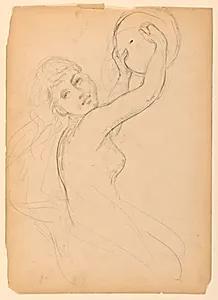
Sketch for a Bacchante
Classification
figures
Department
Smithsonian Collection
Museum
Smithsonian American Art Museum
Credit
Bequest of Erskine Hewitt
Accession Number
1942-50-132
Rights
Public Domain
About this artwork
Research in Progress
Art Historical Context
**Sketch for a Bacchante *Daniel Huntington (American, 1816–1906), 1887 Daniel Huntington, a leading figure in 19th-century American art president of the National Academy Design from 1862 to 1890, created this preparatory sketch late in his prolific career. Known for his portraits, historical scenes, and neoclassical subjects, Huntington often drew inspiration from classical mythology, blending European academic traditions with American sensibilities. This work, classified as a figure study, captures a Bacchante—a fervent female follower of Bacchus, the Roman god wine and revelry—evoking the ecstatic dances and wild rituals of ancient Dionysian festivals. As a sketch from 1887, it likely served as a dynamic groundwork for a larger painting, showcasing Huntington's skill in rendering fluid movement and expressive poses. Though the medium remains unidentified amid ongoing research, such studies were essential in the academic process, allowing artists to refine anatomy, drapery, and emotion before committing to canvas. The piece highlights the enduring appeal of Greco-Roman themes in Gilded Age America, where mythology symbolized both cultural sophistication and untamed vitality. Now in the Smithsonian American Art Museum through the bequest of collector Erskine Hewitt, this artwork offers a glimpse into Huntington's studio practice and the artistic dialogue between antiquity and modernity. Visitors can appreciate how a simple sketch bridges historical myth with the artist's innovative vision.