
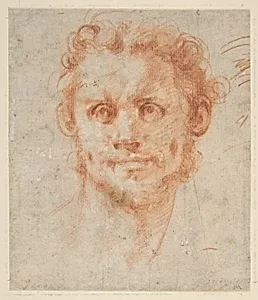
Study of a Man's Head
Medium
Red chalk; stumping
Dimensions
Sheet: 5 1/4 × 4 1/2 in. (13.3 × 11.4 cm)
Classification
Drawings
Department
Drawings and Prints
Museum
Metropolitan Museum of Art, New York, NY
Credit
Purchase, Pfeiffer and Harry G. Sperling Funds, Gift of Dr. Mortimer D. Sackler, Theresa Sackler and Family, and Karen B. Cohen Fund, 1998
Accession Number
1998.361
Rights
Public Domain
Tags
Art Historical Context
In the early 1520s, Jacopo da Pontormo (opo Carucci), a leading Florentine Mannerist painter, captured this intimate *Study of a Man's Head using red chalk on a modest sheet measuring just 5¼ × 4½ inches. Created around 1520–25, during the transition from High Renaissance ideals to Mannerism's expressive distortions, the drawing exemplifies Pontormo's with human emotion and form. Working in Florence under influences like Michelangelo and Andrea del Sarto he produced preparatory studies like this one, likely for larger frescoes or altarpieces, honing his signature style of elongated features and psychological depth. The medium of red chalk, enhanced by stumping—a technique of blending tones with a soft tool—creates subtle modeling and a lifelike softness in the man's furrowed brow and intense gaze. This method allowed artists of the period to achieve sfumato-like effects, bridging drawing and painting. Pontormo's drawings were treasured for their immediacy, offering glimpses into the creative process amid Renaissance Italy's artistic fervor. Today, housed in the Metropolitan Museum of Art's Drawings and Prints department, this poignant portrait study invites visitors to ponder the anonymous man's story, revealing Mannerism's emphasis on inner turmoil over classical harmony. A testament to Pontormo's innovative draftsmanship, it reminds us how small sketches fueled grand masterpieces.