
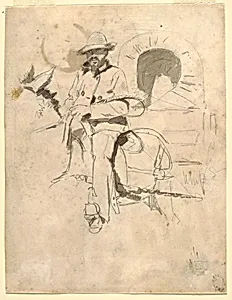
Study of a Teamster
Medium
figures
Classification
figures
Department
Smithsonian Collection
Museum
Smithsonian American Art Museum
Credit
Gift of Charles Savage Homer, Jr.
Accession Number
1912-12-201
Rights
Public Domain
About this artwork
Research in Progress
Art Historical Context
Winslow Homer's *Study of a Teamster (1862) captures the rugged essence of American life during the Civil War era. Born in Boston in 1836, Homer rose from commercial illustrator to one of America's foremost realist painters, renowned for his unflinching depictions of ordinary people amid extraordinary times. This work, a preparatory study focused on human figures, reflects his early fieldwork as a special correspondent for *Harper's Weekly*, sketching soldiers, laborers, and scenes from the front lines. Created in the pivotal year of 1862—amid major Union setbacks like the Peninsula Campaign—the piece likely portrays a teamster, a vital wagon driver who hauled supplies for armies. These unsung heroes embodied the gritty backbone of wartime logistics, and Homer's keen eye for anatomy and movement highlights their physicality and determination. As a figure study, it showcases his mastery of graphite or charcoal techniques (common in his sketches), emphasizing form, shadow, and candid realism over idealization. Housed in the Smithsonian American Art Museum through a family gift, this intimate work reveals Homer's evolving style, bridging illustration and fine art. It invites us to appreciate the human cost and resilience behind historical events, making the everyday heroic. (198 words)