
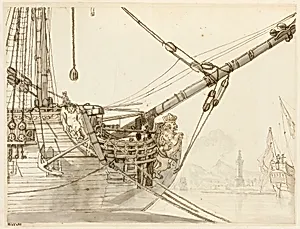
Study of a Warship's Prow with British Warships and Naples Harbor Beyond
c. 1748
Medium
Pen and iron gall ink, with brush and dark gray, light gray and brownish gray wash, over black chalk, on ivory laid paper, laid down on ivory laid paper
Dimensions
Primary support: 36.6 × 47.9 cm (14 7/16 × 18 7/8 in.); Secondary support: 45.8 × 53.7 cm (18 1/16 × 21 3/16 in.)
Classification
drawings (visual works)
Department
Prints and Drawings
Museum
Art Institute of Chicago
Accession Number
207321
Rights
Public Domain
About this artwork
Like many French artists, Claude Vernet made a pilgrimage to Rome, remaining for almost 30 years (1734–63). While there he made excursions across Italy, executing drawings “on the spot.” In the late 1740s, he spent some time in Naples, near the classical sites rediscovered at Herculaneum in 1738 and at Pompeii in 1748. He became famous for his series of views of the ports of France, commissioned in 1753.
Art Historical Context
Claude Joseph Vernet, a of marine painting in 18th-century France, created this intricate *Study of a Warship's Prow with British Warships and Naples Harbor* around 1748. Vernet, often called the "father of modern seascape," spent much of his career capturing the drama of the sea, blending Rococo elegance with a growing interest in naturalistic detail. This drawing depicts the imposing prow of a warship in the foreground, with British vessels and the bustling Naples harbor receding into the distance—a snapshot of Mediterranean naval life during an era of European maritime rivalry. Executed in pen and iron gall ink with layered washes of gray and brown over black chalk on laid paper, the work showcases Vernet's virtuoso technique. Iron gall ink, prized for its rich, enduring lines, allowed for precise hatching and cross-hatching to evoke texture and depth, while the subtle washes build atmospheric perspective. As a preparatory study (36.6 × 47.9 cm), it likely informed larger oil paintings, highlighting how draftsmen like Vernet refined compositions through such meticulous sketches. Housed in the Art Institute of Chicago's Prints and Drawings Department, this piece offers a window into Vernet's Roman sojourn and his fascination with naval architecture amid geopolitical tensions. Visitors will appreciate its technical finesse and evocative portrayal of 18th-century seafaring power.
About the Artist
Claude Joseph Vernet · 1714–1789
Claude-Joseph Vernet and his direct descendants are the last representatives of the Avignon School which had provided a continuous line of artists since the 14th century. It originated at the time when Bernard de Goth, Archbishop of Bordeaux, became pope in the name of Clement V and transferred the seat of the papacy to Avignon where he established an influential artistic community. Comment on wor...