
Study for "The Signal of Distress"
Medium
seascapes
Classification
seascapes
Department
Smithsonian Collection
Museum
Smithsonian American Art Museum
Credit
Gift of Charles Savage Homer, Jr.
Accession Number
1912-12-43
Rights
Public Domain
About this artwork
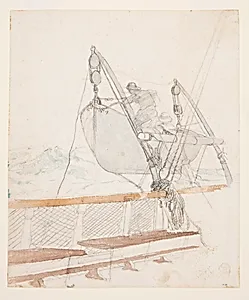
Vertical view from bridge of ship, showing railing with benches and stormy sea beyond, as two men work in a lifeboat with ropes and pulleys, at center right.
Art Historical Context
Winslow Homer, one of America's foremost realist painters (1836–1910), created *Study for "The Signal Distress"* in 1881, capturing the raw drama of maritime peril. This preparatory work offers a vertical view from a ship's bridge, framing a railing with benches against a turbulent sea. At center right, two men labor intensely in a lifeboat, maneuvering ropes and pulleys amid the storm—a poignant snapshot of human tenacity against nature's fury. Homer seascapes, like this one from the Smithsonian American Art Museum collection, reflect his deep immersion in coastal life after moving to Maine in the 1880s. As a study, it reveals his meticulous process: sketching compositions to refine larger oils, emphasizing dynamic composition and atmospheric tension. His realist style, honed through Civil War illustrations and later marine subjects, underscores the perilous realities of 19th-century seafaring, evoking empathy for sailors' struggles. Gifted by Charles Savage Homer, Jr., this piece highlights Homer's enduring legacy in American art, blending technical precision with emotional depth. Visitors will appreciate how it foreshadows the monumental *The Signal of Distress*, immortalizing the sea's unforgiving power.