
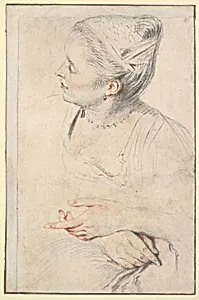
Study of a Woman's Head and Hands
ca. 1717
Medium
Red and white chalk and graphite on off-white laid paper
Dimensions
Sheet: 7 1/2 x 5 in. (19 x 12.7 cm)
Classification
Drawings
Department
Drawings and Prints
Museum
Metropolitan Museum of Art, New York, NY
Credit
Gift of Mrs. Charles Wrightsman, 2012
Accession Number
2012.150.1
Rights
Public Domain
Tags
Art Historical Context
Antoine Watteau, a master of the French Rococo style, created this delicate *Study of a Woman's Head and Hands* around 1717, during the vibrant Regency era following Louis XIV's death. Known for his enchanting *fêtes galantes*—scenes of elegant revelry in pastoral settings—Watteau was equally celebrated for his preparatory drawings, which captured the fluid grace and emotional subtlety of the human figure. This intimate sheet, now in the Metropolitan Museum of Art, exemplifies his genius in translating three-dimensional form onto paper with remarkable tenderness. Executed in red and white chalk with graphite on off-white laid paper, the work measures just 7½ x 5 inches, highlighting Watteau's preference for mixed-media techniques that allowed for soft modeling of flesh tones and subtle highlights. The red chalk lends warmth to the woman's serene face and expressive hands, while white chalk accentuates contours and graphite adds precise lines—methods that influenced generations of artists seeking naturalistic effects without the rigidity of oil paint. As a study rather than a finished piece, it reveals Watteau's working process, likely preparatory for one of his poetic compositions. Donated to the Met in 2012, this gem invites visitors to appreciate the artist's unparalleled sensitivity to light, texture, and human emotion, bridging the opulent world of 18th-century French art with timeless intimacy.
About the Artist
Antoine Watteau · 1684–1721
Jean-Antoine Watteau, born in 1684 in Valenciennes to a modest family—his father a roofer named Jean-Philippe Watteau—was the second of four sons who displayed an early passion for art. After initial apprenticeship under local painter Jacques-Albert Gérin, he moved to Paris around 1702, working in workshops copying Flemish and Dutch genre scenes. By 1705, he entered the studio of Claude Gillot, ab...