
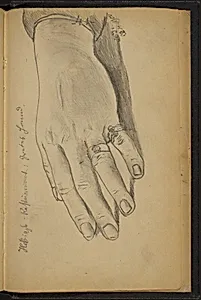
Study of a Woman's Hand with Rings
1900
Medium
graphite on wove paper
Classification
Drawing
Department
CG-W
Museum
National Gallery of Art, Washington, D.C.
Credit
Gift of Mrs. Max Beckmann
Accession Number
1984.64.64.155
Rights
Public Domain
Art Historical Context
Max Beckmann's *Study of a Woman's Hand with Rings* (1900) is an intimate graphite drawing on wove paper, capturing the delicate anatomy and adornments of a feminine hand. Created when Beckmann was just 16, this early work showcases the young artist's budding mastery of form and texture. The smooth wove paper provides an ideal surface for the fine gradations of graphite, allowing precise shading that renders the skin's subtle contours, the gleam of metal rings, and the sparkle of gems with remarkable realism. As one of Beckmann's earliest surviving studies, it reflects his academic training in Weimar, where he honed classical techniques before evolving into a leading Expressionist. Hand studies like this were foundational exercises for artists, emphasizing anatomy, light, and shadow—skills that would later fuel his bold, symbolic figures in paintings and prints. Donated to the National Gallery of Art by Mrs. Max Beckmann, it offers a personal glimpse into the artist's formative years. This modest drawing holds cultural weight as a testament to the meticulous preparatory work behind modernist masterpieces, inviting viewers to appreciate the quiet precision that underpinned Beckmann's dramatic career.
About the Artist
Max Beckmann · 1884–1950
Max Carl Friedrich Beckmann (1884-1950) stands as one of the most significant German painters of the twentieth century, a complex artist who bridged Expressionism and the New Objectivity while forging a deeply personal visual language. Born in Leipzig into a middle-class family, Beckmann's artistic journey spanned from academic classicism through the traumatic crucible of World War I to a mature s...