
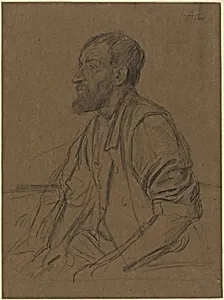
Study of a Workman
1826 to 1850
Medium
graphite on brown paper
Dimensions
overall (approximate): 26.5 x 19.6 cm (10 7/16 x 7 11/16 in.)
Classification
Drawing
Department
CG-E
Museum
National Gallery of Art, Washington, D.C.
Credit
Rosenwald Collection
Accession Number
1943.3.5488
Rights
Public Domain
Art Historical Context
"Study of a Workman is a poignant graphite drawing on brown paper by French artist Alphonse Legros created sometime between 1826 and1850. Measuring approximately 26.5 19.6 cm, intimate sketch belongs to the National Gallery of Art'swald Collection in the CG-E Department. As a classified drawing, it exemplifies the preparatory studies that artists like Legros used to explore form, light, and human expression before committing to larger works. The choice of graphite on brown paper was a practical yet evocative technique in the 19th century, allowing for subtle tonal gradations and rich contrasts that mimic the textures of skin and clothing. Legros, associated with Realism, often turned his gaze to ordinary laborers, reflecting a growing artistic interest in the dignity of working-class life amid Europe's industrial changes. This workman—likely rendered with quick, assured lines—invites us to appreciate the quiet heroism in everyday toil. Housed in a prestigious collection, this modest study highlights Legros's skill in capturing fleeting moments, bridging French academic traditions with emerging modernist sensibilities. A gem for drawing enthusiasts, it reminds us how small sketches can reveal profound human stories.
About the Artist
Alphonse Legros · 1837–1911
Alphonse Legros (1837–1911) was born in Dijon, France, and trained in Paris at the drawing school of Horace Lecoq de Boisbaudran, whose unconventional teaching method — which emphasised memory drawing and acute observation over academic convention — would leave a lasting mark on Legros's practice. At Lecoq's school he formed friendships with Jules Dalou and Auguste Rodin that endured throughout hi...