
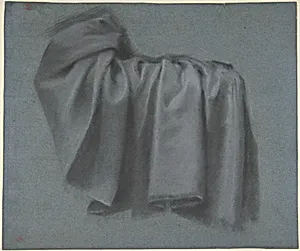
Study of Drapery
ca. 1813
Medium
Black and white chalk with stumping on blue paper, some squaring in black chalk
Dimensions
10 1/16 x 10 1/4 in. (25.5 x 26 cm)
Classification
Drawings
Department
Drawings and Prints
Museum
Metropolitan Museum of Art, New York, NY
Credit
Purchase, Guy Wildenstein Gift, 2008
Accession Number
2008.44
Rights
Public Domain
Tags
Art Historical Context
Pierre-Paul Prud’hon’s “Study of Drapery,” created around 1813, captures the quiet poetry of fabric in motion. Working on luminous blue paper, the French artist used black and white chalk with delicate stumping to model the soft folds of a dress. This technique allows light to appear to caress the cloth, giving the study a sculptural presence despite its modest size of roughly ten inches square. As a preparatory drawing, the work reveals Prud’hon’s meticulous process. The faint squaring lines indicate he planned to transfer the design to a larger composition, a common practice among neoclassical artists. The careful attention to how light and shadow play across the material underscores his reputation for creating atmospheric effects that bridge the clarity of neoclassicism with the emotional warmth of romanticism. Today housed in the Metropolitan Museum of Art’s Department of Drawings and Prints, this sheet offers visitors a rare glimpse into an artist’s studio practice. It reminds us that even the most graceful painted gowns began as thoughtful studies of texture, weight, and light.
About the Artist
Pierre Paul Prud'hon · 1758–1823
Pierre Paul Prud'hon (1758–1823) was a French painter and draughtsman whose dreamy, sensuous art occupied a singular position between the Neoclassicism and Romanticism that competed for dominance in French painting around 1800. Born in Cluny in Burgundy, he received his early artistic training at the Dijon Academy before winning the Prix de Rome of the Estates of Burgundy, which allowed him to spe...