
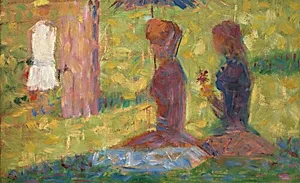
Study of Figures for "La Grande Jatte"
1884/1885
Medium
oil on wood
Dimensions
overall: 15.24 × 24.13 cm (6 × 9 1/2 in.)
Classification
Painting
Department
CF
Museum
National Gallery of Art, Washington, D.C.
Credit
Collection of Mr. and Mrs. Paul Mellon
Accession Number
2014.18.57
Rights
Public Domain
Art Historical Context
Georges Seurat created this intimate oil study on wood panel in 1884–1885 as he prepared his monumental masterpiece, *A Sunday Afternoon on the Island of La Grande Jatte*. The small work captures early explorations of figures that would later populate the large canvas, revealing the artist’s meticulous approach to composition. Seurat, a leading figure in the Neo-Impressionist movement, sought to bring scientific precision to painting through optical mixing of color. Measuring just six by nine-and-a-half inches, the panel demonstrates Seurat’s innovative Pointillist technique, in which tiny dots of pure pigment are applied side by side so that the viewer’s eye blends them at a distance. Working on wood rather than canvas allowed him to experiment quickly with poses, light effects, and spatial arrangements before committing to the final, much larger work. Today housed in the National Gallery of Art as part of the Mellon Collection, this study offers visitors a rare glimpse into Seurat’s working process and the birth of one of the most celebrated paintings of the nineteenth century.
About the Artist
Georges Seurat · 1859–1891
Georges Seurat (1859-1891) was the founder of Neo-Impressionism and the inventor of Pointillism, a revolutionary technique that transformed how artists understand and apply color. In a tragically brief career cut short at age 31, Seurat produced only seven monumental paintings, yet his systematic application of color theory fundamentally altered the direction of modern art. Born in Paris to a pro...