
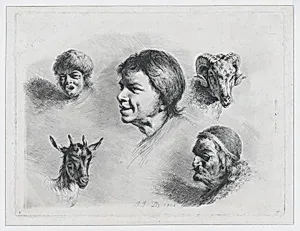
Study of Five Heads
Medium
Etching; first state of two
Dimensions
Sheet: 7 in. × 9 1/4 in. (17.8 × 23.5 cm) Plate: 6 1/2 × 8 9/16 in. (16.5 × 21.8 cm)
Classification
Prints
Department
Drawings and Prints
Museum
Metropolitan Museum of Art, New York, NY
Credit
Harris Brisbane Dick Fund, 1917
Accession Number
17.3.1975
Rights
Public Domain
Tags
Art Historical Context
Jean-Jacques de Boissieu's *Study of Five Heads*1803) is a captivating etching from the artist's late career, capturing an intimate array of human and animal visages. Created as the first state of two this print showcases Boissieu's mastery of the etching technique, where acid bites into a metal plate to produce rich, nuanced lines and textures. Measuring just 7 by 9¼ inches, the sheet invites close viewing, revealing the subtle interplay of light and shadow that defines his Rembrandt-inspired style. Working in Lyon, France, during the Napoleonic era, Boissieu drew from 17th-century Dutch traditions, blending portraiture with everyday observation. The composition features heads of boys and men alongside an animal—likely evoking rustic life or character studies common in his oeuvre. These subjects, rendered with delicate hatching and burr for atmospheric depth, highlight etching's versatility as a medium for exploratory sketches turned into finished works. The "first state" denotes its pristine form before later revisions, offering collectors a glimpse into the artist's process. Acquired through the Harris Brisbane Dick Fund in 1917, this print resides in The Metropolitan Museum of Art's Drawings and Prints department. It exemplifies Boissieu's contribution to French printmaking, bridging Rococo elegance with Romantic introspection, and remains a gem for those appreciating the tactile poetry of etched lines.
About the Artist
Jean Jacques de Boissieu · 1736–1810
French, Lyons 1736–1810 Lyons