
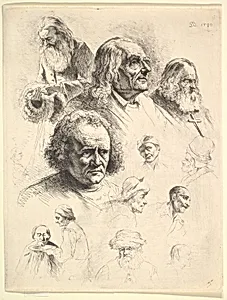
Study of Thirteen Heads
Medium
Etching with drypoint; second state of three
Dimensions
Sheet: 9 7/16 × 7 3/16 in. (24 × 18.3 cm) Plate: 9 1/4 × 7 1/16 in. (23.5 × 17.9 cm)
Classification
Prints
Department
Drawings and Prints
Museum
Metropolitan Museum of Art, New York, NY
Credit
The Elisha Whittelsey Collection, The Elisha Whittelsey Fund, 1967
Accession Number
67.793.25
Rights
Public Domain
Tags
Art Historical Context
Jean-Jacques de Boissieu's *Study of Thirteen Heads* (1770) is a captivating etching with drypoint, capturing the expressive faces of thirteen men in a compact composition. Housed in the Metropolitan Museum of Art's Drawings and Prints department, this second state of three impressions showcases the artist's meticulous skill in rendering varied physiognomies—from weathered profiles to intense gazes—evoking the human condition with remarkable intimacy. Measuring just over 9 by 7 inches, the sheet invites close viewing, revealing the subtle textures born from Boissieu's combined techniques. Etching, where acid etches lines into a copper plate, pairs beautifully with drypoint's direct, burr-rich scratches, which add velvety softness and depth reminiscent of Rembrandt's influence. Boissieu, a Lyon-based French printmaker active in the late Enlightenment era, excelled in such character studies, blending Rococo elegance with emerging Realism. This work highlights his prowess in multi-figure prints, a format that allowed exploration of social types and emotions. As part of The Elisha Whittelsey Collection, it exemplifies 18th-century printmaking's democratic appeal—affordable art for collectors—while underscoring Boissieu's legacy in preserving fleeting human expressions through enduring technique. A true gem for print enthusiasts!
About the Artist
Jean Jacques de Boissieu · 1736–1810
French, Lyons 1736–1810 Lyons