
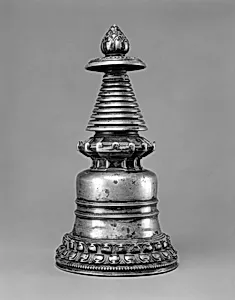
Stupa
Unknown Artist
13th century
Medium
Brass
Dimensions
H. 8 5/16 in. (21.1 cm)
Classification
Metalwork
Culture
Western Tibet
Department
Asian Art
Museum
Metropolitan Museum of Art, New York, NY
Credit
Gift of Mr. and Mrs. Walter Eisenberg, 1982
Accession Number
1982.460.4
Rights
Public Domain
Tags
Art Historical Context
This exquisite brass stupa, crafted in Western Tibet during the 13 century, stands as a miniature marvel of Buddhist devotion. Measuring just over 8 inches tall, it exemplifies the region's masterful metalwork traditions, likely produced through lost-wax casting—a technique that allowed for intricate detailing on a small scale. Donated to the Metropolitan Museum of Art 1982 by Mr. and Mrs. Walter Eisen, it now graces the Asian Art galleries, inviting visitors to ponder its sacred geometry. In Tibetan Buddhism, stupas symbolize the enlightened mind of the Buddha, encapsulating his life, teachings, and path to nirvana. This 13th-century example hails from a pivotal era when Western Tibet flourished under the influence of the Sakya and early Phagmodrupa dynasties, blending Indian, Nepalese, and local artistic motifs. The stupa's classic form—featuring a hemispherical dome, multi-tiered spire (chhatra), and harmika square—represents the five cosmic elements, serving as both a relic container and a meditative focal point. Its cultural significance endures as a testament to portable piety; devotees could carry or place such models in home shrines for merit-making. Though by an unknown artist, its refined brass patina and symbolic purity highlight the anonymous genius of Tibetan craftsmen, bridging spirituality and artistry across centuries.