
Sugar Bowl
ca. 1760
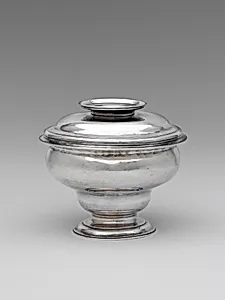
Medium
Silver
Dimensions
3 7/8 in., 312.9g (9.8 cm, 10 oz, 1 dwt..) Lip diameter: 4 1/8 in. (10.5 cm) Diam. of foot: 2 5/8 in. (6.7 cm) Other (Body): 3 in., 182.1g (7.6 cm, 5.855 oz.) Other (Cover): 1 1/16 × 4 9/16 in., 130.8g (2.7 × 11.6 cm, 4.205oz.)
Classification
Sugar Bowl
Culture
American
Department
The American Wing
Museum
Metropolitan Museum of Art, New York, NY
Credit
Gift of The Estate of Esther and Samuel Schwartz, Paterson, N.J., 2007
Accession Number
2007.471.2a, b
Rights
Public Domain
Art Historical Context
In the elegant world of colonial American silver, Daniel Christian Fueter's *Sugar Bowl* (ca. 1760) stands as a exquisite example of craftsmanship from New premier silversmiths. Fueter, a immigrant who established a prominent workshop in the city during the mid-18 century, produced luxury domestic wares for the elite. Crafted from gleaming silver, covered bowl—measuring about 3 /8 inches tall with a 4 1/8-inch lip diameter—itomizes the Rococo popular in the period, with its graceful proportions and functional yet refined design. Silver objects like this sugar bowl were status symbols in prosperous households, used to serve refined sweeteners imported from the Caribbean amid growing transatlantic trade. Weighing a substantial 312.9 grams total (including body and cover), it reflects the material's rarity and value in pre-Revolutionary America, where local silversmiths vied with British imports. Housed in The Metropolitan Museum of Art's American Wing, this piece, gifted from the Estate of Esther and Samuel Schwartz in 2007, offers a tangible link to everyday opulence 1760s New York society. Fun fact: The bowl's footed base (2 5/8 inches in diameter) stability on tea tables, blending utility with artistry in a time when such items doubled as heirlooms.