
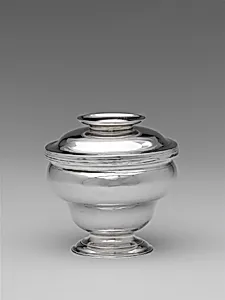
Sugar Bowl
1750–60
Medium
Silver
Dimensions
Overall: H. 4 in. (10.2 cm); 9 oz. 6 dwt. (289.7 g) Lip: Diam. 4 in. (10.2 cm) Foot: Diam. 2 9/16 in. (6.5 cm) Body: H. 3 3/16 in., 163.6 Grams (8.1 cm, 5.26 Troy Ounces) Cover: 1 1/16 x 4 1/16 in., 126.1 Grams (2.7 x 10.3 cm, 4.054 Troy Ounces)
Classification
Sugar Bowl
Culture
American
Department
The American Wing
Museum
Metropolitan Museum of Art, New York, NY
Credit
Gift of Miss Mary T. Cockcroft, 1928
Accession Number
28.88.1a, b
Rights
Public Domain
Art Historical Context
Nestled in The American Wing of the Metropolitan Museum of Art this elegant sugar bowl exemplifies mid-18th-century Americanversmithing. Crafted by Nicholas Roosevelt between 1750 and 1760, the piece is made of fine silver, weighing a substantial 9 ounces and 6 pennyweights (289.7 grams) overall. Its graceful proportions—standing 4 inches tall with a 4-inch diameter lip and sturdy 2 9/16-inch footreflect the precision and skill of colonial artisans working in New York, where Roosevelt was active. Sugar bowls like this one were prized possessions in affluent colonial households, symbolizing wealth and refinement. Sugar, an expensive imported commodity from the Caribbean, was served in such vessels during tea rituals that mimicked British high society. The medium of silver not only ensured durability but also allowed for gleaming surfaces that caught the light, enhancing table settings. Divided into body (3 3/16 inches high, 5.26 troy ounces) and cover (1 1/16 x 4 1/16 inches, 4.054 troy ounces), the bowl's construction highlights the meticulous techniques of the era, from hammering and seaming to polishing. Gifted to the Met in 1928 by Miss Mary T. Cockcroft, this artifact offers a tangible link to America's early decorative arts tradition, inviting visitors to imagine the clink of silver amid revolutionary times.