
Sugar bowl
1760 (?)
Medium
Soft-paste porcelain
Dimensions
4 × 3 1/2 in. (10.2 × 8.9 cm)
Classification
Ceramics-Porcelain
Culture
French, possibly Sèvres
Department
European Sculpture and Decorative Arts
Museum
Metropolitan Museum of Art, New York, NY
Credit
Joint Bequest of Harriet K. and Grace Wilkes, 1922
Accession Number
22.45.18a, b
Rights
Public Domain
Tags
Art Historical Context
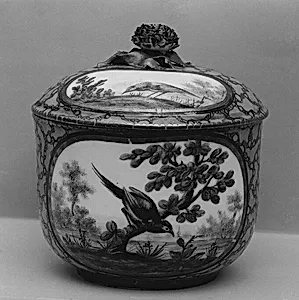
This delicate sugar bowl, crafted by the renowned Sèvres Manuf around 1760, exemplifies pinnacle of 18th-century French porcelain artistry. Made from soft-paste porcelain refined, creamy material prized for its translucency and ability to hold intricate decorations—the bowl measures just 4 × 3½ inches, perfect for intimate table settings among the elite. Its surface likely features hand-painted motifs of birds perched among trees, capturing the naturalistic elegance of the Rococo style, which favored whimsical, organic forms during Louis XV's reign. Sèvres, established as a royal factory in 1756, produced luxury goods like this for Versailles and aristocratic homes, where sugar—a rare import from the colonies—symbolized wealth and refinement. Soft-paste porcelain, an earlier European innovation before Chinese hard-paste techniques were mastered, allowed for vibrant enamel colors and gilding that mimicked precious metals. This piece reflects the era's cultural fusion of art and domestic life, blending technical virtuosity with decorative charm. Now in the Metropolitan Museum of Art's European Sculpture and Decorative Arts collection, thanks to the 1922 bequest of Harriet K. and Grace Wilkes, the sugar bowl invites us to savor the opulence of ancien régime France. Imagine it gracing a salon, where birds in leafy boughs evoked pastoral escapes amid courtly splendor.
About the Artist
Sèvres Manufactory · 1740–present
The Sèvres Manufactory, one of Europe's premier porcelain producers, was established in 1740 as the Manufacture de Vincennes under the patronage of Queen Marie Leszczyńska, who sought to rival Meissen and Chantilly porcelains with French soft-paste innovations. Initially a private venture, it relocated to Sèvres in 1756 in a purpose-built facility designed by architect Laurent Lindet near Madame d...