
Sugar bowl
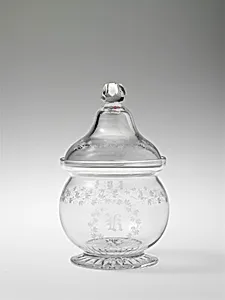
Medium
Blown and engraved glass
Dimensions
H. 7 1/2 in. (19.1 cm); Diam. 4 1/4 in. (10.8 cm)
Classification
Sugar bowl
Culture
American
Department
The American Wing
Museum
Metropolitan Museum of Art, New York, NY
Credit
Funds from various donors, 1967
Accession Number
67.7.24a, b
Rights
Public Domain
Art Historical Context
This elegant sugar bowl, crafted by the Boston & Sandwich Glass Company between 1865 and 1875, exemplifies the refined glassmaking traditions of 19th-century America. Standing 7½ inches tall with a graceful 4¼-inch diameter, the vessel was formed through the demanding technique of blowing glass by hand before skilled artisans added delicate engraved patterns. Such pieces were staples of Victorian dining tables, where they held a precious commodity—refined sugar—highlighting both domestic refinement and the growing industrial capabilities of the United States. The Boston & Sandwich Glass Company, based in Massachusetts, played a vital role in establishing America’s reputation for high-quality glassware during the post-Civil War era. By combining traditional free-blown methods with precise engraving, the company created objects that balanced everyday utility with artistic beauty. This sugar bowl, now part of the Metropolitan Museum of Art’s American Wing, offers visitors a window into the material culture of the time, when finely crafted household items reflected both technological progress and aesthetic aspirations.
About the Artist
Boston & Sandwich Glass Company · 1825–1888
The Boston & Sandwich Glass Company, a pioneering force in American glassmaking, was established in 1825 in Sandwich, Massachusetts, by visionary entrepreneur Deming Jarves, who had honed his expertise as an agent for the New England Glass Company in Cambridge. Jarves built the factory on the banks of the Cape Cod Canal, incorporating it formally the following year with Boston investors. Drawing o...