
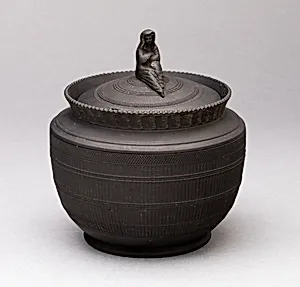
Sugar Bowl
1810/20
Medium
Stoneware (basaltware)
Dimensions
H.: 14 cm (5 1/2 in.)
Classification
sugar bowl
Department
Applied Arts of Europe
Museum
Art Institute of Chicago
Accession Number
27305
Rights
Public Domain
Art Historical Context
This elegant sugar bowl, crafted from basaltware stoneware between 1810 and 1820, reflects the refined tastes of early nineteenth-century Europe. Basaltware, a dense, unglazed black ceramic developed in the late 1700s, was prized for its matte finish that mimicked ancient basalt stone. It allowed makers to produce durable yet sophisticated tableware suited to the growing fashion for tea drinking among the middle and upper classes. As part of the Art Institute of Chicago’s Applied Arts of Europe collection, the piece highlights how functional objects became vehicles for neoclassical design. Its compact form, standing just 14 centimeters tall, would have complemented matching tea services, emphasizing harmony and restraint over ornament. Though the artist remains unknown, the work speaks to the widespread adoption of industrial ceramic techniques that made stylish household items more accessible. Such vessels also carried cultural weight, symbolizing hospitality and social ritual during an era when sugar was still a relative luxury. This unassuming object invites visitors to consider how everyday items shaped domestic life and aesthetic values across Europe.
About the Artist
Unknown
The artist designated as "Unknown" in our virtual museum's collection exemplifies a poignant chapter in art history: creators whose identities have faded into obscurity despite the enduring power of their work. With only one known artwork attributed to them in our holdings, this figure represents countless anonymous hands that shaped visual culture across centuries. Museums worldwide, including th...