
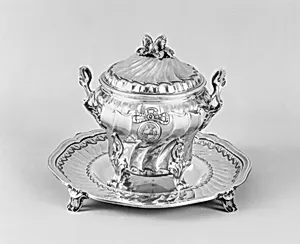
Sugar bowl with cover and tray
Medium
Silver
Dimensions
Height (sugar bowl with cover .264a, b): 5 3/8 in. (13.7 cm); Diameter (tray .265): 7 7/8 in. (20 cm)
Classification
Metalwork-Silver
Culture
French, Paris
Department
European Sculpture and Decorative Arts
Museum
Metropolitan Museum of Art, New York, NY
Credit
Bequest of Catherine D. Wentworth, 1948
Accession Number
48.187.264a, b, .265
Rights
Public Domain
Art Historical Context
This elegant sugar bowl with cover and tray crafted by Parisian silversmith Alexandre desy the Younger in 177778, exemplifies the refined metalwork of late 18th-century France. Made of gleaming silver, the set stands 5⅜ inches tall (with cover) and features a tray with a 7⅞-inch diameter, perfect for displaying luxury confections in affluent homes. As a product of Paris workshops, it bears the hallmarks of French craftsmanship during the waning years of the Ancien Régime, just before the Revolution upended aristocratic opulence. Silver services like this were status symbols, reserved for the elite who savored imported sugar—a rare and costly spice symbolizing wealth. Roussy's work reflects the transition from ornate Rococo to the cleaner lines of Neoclassicism, showcasing technical mastery in chasing, engraving, and gilding typical of the era's guild-trained artisans. Housed in The Metropolitan Museum of Art's European Sculpture and Decorative Arts Department through the 1948 bequest of Catherine D. Wentworth, it offers a tangible glimpse into the sophisticated domestic rituals of pre-Revolutionary Paris.