
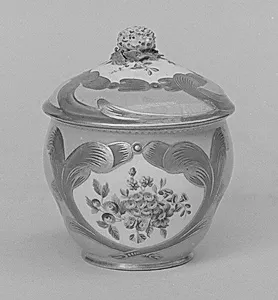
Sugar bowl with cover (pot à sucre Hébert) (part of a service)
Medium
Soft-paste porcelain
Dimensions
Height: 3 3/4 in. (9.5 cm)
Classification
Ceramics-Porcelain
Culture
French, Sèvres
Department
European Sculpture and Decorative Arts
Museum
Metropolitan Museum of Art, New York, NY
Credit
Gift of Samuel H. Kress Foundation, 1958
Accession Number
58.75.97a, b
Rights
Public Domain
Tags
Art Historical Context
This delicate sugar bowl with cover, as a *pot à sucre Hébert*, exemplifies the opulence of mid-18th-century French from the renowned Sèvres Manuf. Created in 1759 under the patronage of Louis XV, it forms part of a larger service, designed for the aristocratic table where sugar—a luxury import from the colonies—sign wealth and refinement. Attributed to decorator Pierre Louis Philippe Armand, piece stands just 3 3/4 inches tall, its petite scale perfect for intimate *déjeuners* or elegant dessert settings. Crafted from soft-paste porcelain, a Sèvres specialty before the adoption of harder Chinese-inspired formulas, this medium allowed for finer molding and intricate painting. Vibrant floral motifs, likely hand-painted in enamels and gilding, evoke the playful Rococo aesthetic of the era, with blooming flowers symbolizing nature's abundance amid Versailles' grandeur. The manufactory's innovations in color and translucency made Sèvres wares coveted across Europe, rivaling Meissen and oriental imports. Today, this gift from the Samuel H. Kress Foundation graces the Metropolitan Museum of Art's European Decorative Arts galleries, offering a glimpse into the lavish material culture of ancien régime France. A testament to technical mastery and royal taste, it reminds us how everyday objects became canvases for artistic splendor.
About the Artist
Sèvres Manufactory|Pierre Louis Philippe Armand · 1740–present
The Sèvres Manufactory, one of Europe's premier porcelain producers, was established in 1740 as the Manufacture de Vincennes under the patronage of Queen Marie Leszczyńska, who sought to rival Meissen and Chantilly porcelains with French soft-paste innovations. Initially a private venture, it relocated to Sèvres in 1756 in a purpose-built facility designed by architect Laurent Lindet near Madame d...