
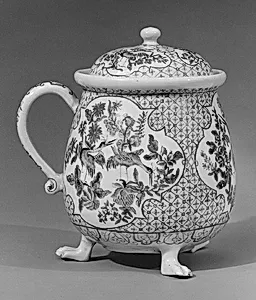
Sugar box with cover
ca. 1719, decorated 1720–30
Medium
Hard-paste porcelain
Dimensions
Height (with cover): 5 3/4 in. (14.6 cm)
Classification
Ceramics-Porcelain
Culture
German, Meissen with German, Augsburg decoration
Department
European Sculpture and Decorative Arts
Museum
Metropolitan Museum of Art, New York, NY
Credit
Gift of Irwin Untermyer, 1970
Accession Number
1970.277.7a, b
Rights
Public Domain
Tags
Art Historical Context
This elegant sugar box with cover, crafted around 1719 at the Meissen Manufactory during its pioneering Böttger period, represents one of Europe’s earliest triumphs in porcelain-making. Johann Friedrich Böttger’s discovery of hard-paste porcelain allowed German artisans to rival the prized imports from China and Japan for the first time. Standing just 5¾ inches tall, the compact vessel was designed for the fashionable tea, coffee, and chocolate services that graced aristocratic tables in the early eighteenth century. The box’s delicate floral, leaf, and bird motifs were added in Augsburg between 1720 and 1730 by the gifted decorator Abraham Seuter. Working on behalf of independent workshops, Seuter enriched the white porcelain surface with lively, colorful enamel painting that reflects both the playful spirit of the Baroque and the emerging taste for naturalistic ornament. Such collaborative production—factory body paired with Augsburg decoration—highlights the vibrant network of specialized craftsmen that spread Meissen’s fame across Europe. Today the piece offers visitors a vivid glimpse of how technical innovation and artistic refinement combined to transform a simple household luxury into a treasured work of art.
About the Artist
Meissen Manufactory|Böttger Period|Abraham Seuter · 1710–present
The Meissen Manufactory, established on June 6, 1710, by Augustus the Strong, Elector of Saxony and King of Poland, marked the dawn of true hard-paste porcelain production in Europe. Nestled at Albrechtsburg Castle in Meissen near Dresden, the Royal Polish and Electoral Saxon Porcelain Manufactory arose from alchemical experiments begun in 1708 by physicist Ehrenfried Walther von Tschirnhaus and p...