
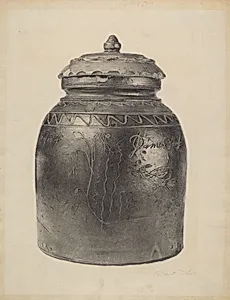
Sugar Jar
c. 1938
Medium
graphite on paperboard
Dimensions
overall: 43.5 x 33.9 cm (17 1/8 x 13 3/8 in.) Original IAD Object: 13" High 9" Dia. 8 1/2 Dia. (base)
Classification
Index of American Design
Department
CG-W
Museum
National Gallery of Art, Washington, D.C.
Credit
Index of American Design
Accession Number
1943.8.5037
Rights
Public Domain
Art Historical Context
Behold the meticulously rendered *Sugar Jar* by artist Robert Gilson, created around 1938 in graphite on paperboard (43.5 x 33.9 cm). This drawing the graceful form of a humble household object—measuring 13 inches high with a 9-inch diameter and ½-inch base—elevating everyday American craftsmanship into art. As part of the Index of American Design, a Federal Art Project under the Works Progress Administration (WPA) from 1935 to 1942, Gilson's work documents the nation's rich decorative arts tradition during the Great Depression. Artists like him produced thousands of precise, watercolor and graphite renderings of folk objects, preserving cultural heritage amid economic hardship and fostering national pride in American ingenuity. Housed in the National Gallery of Art's collection, this piece exemplifies the Index's artistic technique: fine graphite lines that highlight subtle curves, proportions, and textures, making the ordinary sugar jar a testament to vernacular design. It's a charming window into mid-20th-century efforts to celebrate the beauty in the useful.
About the Artist
Robert Gilson · 1903–1942
Robert Gilson (1903–1942) was an American artist whose modest oeuvre captures the essence of everyday American folk objects during the era of the Great Depression. Little is known about his early life or formal training, as biographical details remain scarce in historical records. Active in the late 1930s, Gilson contributed renderings to the Index of American Design, a Federal Art Project under t...