
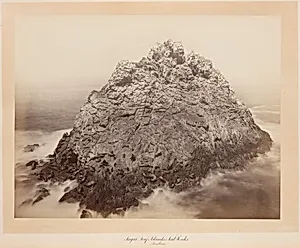
Sugar Loaf Islands, Farallons
1868–69
Medium
Albumen silver print from glass negative
Dimensions
Image: 40 x 52.4; Mount: 55.3 x 66.3
Classification
Photographs
Department
Photographs
Museum
Metropolitan Museum of Art, New York, NY
Credit
Gilman Collection, Gift of The Howard Gilman Foundation, 2005
Accession Number
2005.100.107
Rights
Public Domain
Tags
Art Historical Context
Carleton E. Watkins, pioneering American photographer of the 19th century, captured rugged majesty of the Sugar Loaf Islands in the Farallon Islands off California's coast in this stunning 1868–69 albumen silver print. Known for his breathtaking landscapes of Yosemite and the American West, Watkins ventured to these remote, windswept rocky outcrops—home to seabirds and seals—to document their dramatic isolation against the vast Pacific. The image, with its towering sea stacks and crashing waves, evokes the sublime power of nature, a theme central to Romantic-era art. Printed from a large glass negative, this mammoth-sized photograph (image: 40 x 52.4 cm) showcases the albumen process's remarkable detail, luminosity, and tonal range, which made it the gold standard for fine art photography in the 1860s. Watkins' technical mastery allowed unprecedented realism, bridging painting and science to bring distant wilderness into galleries. Part of the Metropolitan Museum of Art's Gilman Collection, this work highlights photography's role in shaping perceptions of America's untamed frontiers, inspiring conservation and wanderlust among viewers even today. A window to the wild Farallones, it reminds us of nature's enduring allure.
About the Artist
Carleton E. Watkins · 1829–1916
Carleton E. Watkins (1829–1916), one of America's pioneering landscape photographers, was born on November 11, 1829, in Oneonta, New York, the eldest of eight children to carpenter John Watkins and innkeeper Julia. Drawn by the Gold Rush, he arrived in San Francisco in 1851 at age 22 alongside childhood friend Collis Huntington, who later became a railroad tycoon. Initially working as a carpenter ...