
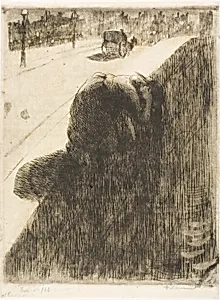
Suicide, plate eleven from Woman
c. 1886
Medium
Etching and aquatint on cream Japanese paper
Dimensions
Plate: 31.8 × 24.7 cm (12 9/16 × 9 3/4 in.); Sheet: 33.9 × 24.7 cm (13 3/8 × 9 3/4 in.)
Classification
etching
Department
Prints and Drawings
Museum
Art Institute of Chicago
Accession Number
27852
Rights
Public Domain
Art Historical Context
Albert Besnard's *Suicide*, plate eleven from the series *Woman* (c. 1886), captures the French artist's fascination with the dramatic and emotional depths of femininity during the fin-de-siècle era. A leading figure in late 19th-century French art, Besnard blended Symbolist tendencies with academic precision, often exploring themes of passion, tragedy, and the human psyche. This poignant etching portrays a moment of profound despair, reflecting broader cultural anxieties about women, modernity, and mortality in post-Impressionist Paris. Printed in etching and aquatint on luxurious cream Japanese paper, the work showcases Besnard's masterful printmaking. Etching allowed for intricate, fluid lines to define forms and expressions, while aquatint added velvety tonal gradations, evoking the richness of oil painting. The choice of Japanese paper—smooth yet textured—enhanced ink absorption, yielding subtle, luminous effects that heightened the image's haunting intensity. Measuring 31.8 × 24.7 cm on the plate, it exemplifies how prints democratized access to high art. Housed in the Art Institute of Chicago's Prints and Drawings department, this piece underscores Besnard's innovative bridge between painting and print, influencing later Symbolists and etchers. Visitors are drawn to its emotional rawness, a window into an era when art boldly confronted life's shadows.
About the Artist
Albert Besnard · 1849–1934
Paul-Albert Besnard, known as Albert Besnard, was born on June 2, 1849, in Paris to an artistic family: his father, Louis Adolphe Ferdinand Besnard, was a history painter and pupil of Ingres, while his mother, Marie Louise Pauline Vaillant, was a noted miniaturist trained under Lizinska de Mirbel. Precociously talented, he began his training under Jean-François Brémond before entering the École de...