
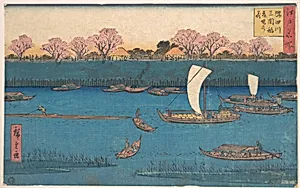
Sumidagawa Mimeguri Hana Zakari no Kei
Medium
Woodblock print; ink and color on paper
Dimensions
8 7/16 x 13 1/2 in. (21.4 x 34.3 cm)
Classification
Prints
Culture & Period
Japan · Edo period (1615–1868)
Department
Asian Art
Museum
Metropolitan Museum of Art, New York, NY
Credit
Purchase, Joseph Pulitzer Bequest, 1918
Accession Number
JP634
Rights
Public Domain
Tags
About this artwork
This landscape print by Utagawa Hiroshige II captures the celebrated cherry blossom viewing spot at Mimeguri along the Sumida River, one of Edo's most famous seasonal destinations. The title "Sumidagawa Mimeguri Hana Zakari no Kei" translates approximately to "View of Cherry Blossoms in Full Bloom at Mimeguri, Sumida River," evoking the hanami (flower viewing) tradition central to Japanese culture. Hiroshige II, adopted pupil of the great landscape master Utagawa Hiroshige, inherited both his te...
Art Historical Context
In the vibrant tradition of ukiyo-e woodblock, Utagawa Hiroshige II's *Sumidagawa Mimeg Hana Zakari no Ke* offers a poetic glimpse of Edo's (modern Tokyo's) Sumida River at its cherry blossom peak. Created during Japan's Edo period (1615–1868), this ink and color print on paper (8 7/16 x 13 1/2 in.) captures the scene at Mimeguri, a premier hanami—flower-viewing—destination. Boats dot the river as revelers gather under blooming sakura, embodying the fleeting beauty of spring that has enchanted Japanese culture for centuries. Hiroshige II, the adopted pupil of the legendary landscape master Utagawa Hiroshige, carried forward the meisho-e style of depicting famous places. Working in the mid-19th century, he infused his teacher's precise observation with a more decorative flair, highlighting Edo's leisure spots where people from all social classes mingled in joyous ritual. This print not only documents a beloved pastime but also reflects the democratic spirit of urban life amid Japan's isolationist era. Acquired through the Joseph Pulitzer Bequest in 1918, the work now graces the Metropolitan Museum of Art's Asian Art collection, preserving a slice of Edo's ephemeral splendor for global audiences.
About the Artist
Utagawa Hiroshige II · 1826–1869
Utagawa Hiroshige II, born Suzuki Chinpei in 1826, was one of the most accomplished ukiyo-e artists of mid-nineteenth century Japan. He entered the studio of the celebrated landscape master Utagawa Hiroshige I — known for his iconic series "The Fifty-three Stations of the Tokaido" — and proved himself the most talented of the elder artist's few students. So highly regarded was the young pupil that...