
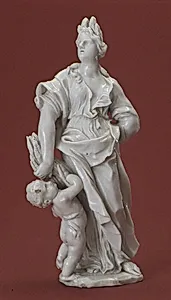
Summer (Ceres)
Medium
Hard-paste porcelain
Dimensions
Height: 8 3/16 in. (20.8 cm)
Classification
Ceramics-Porcelain
Culture
Italian, Florence
Department
European Sculpture and Decorative Arts
Museum
Metropolitan Museum of Art, New York, NY
Credit
Purchase, The Charles E. Sampson Memorial Fund and Gift of J. Pierpont Morgan, by exchange, 1982
Accession Number
1982.28
Rights
Public Domain
Tags
Art Historical Context
Behold *Summer (Ceres)*, a delicate hard-paste porcelain figurine from the Doccia Porcelain Manufactory Florence, Italy, dating to around 1760–70. Attributed in part to the influential sculptor Balthasar Permoser, 8 3/16-inch (20.8 cm) sculpture the Roman goddess Ceres—symbol of agriculture and the harvest—personifying the season of summer. Flanked by frolicsome putti (cherubic), she evokes abundance with her flowing drapery and classical pose, blending mythological grace with Rococo playfulness. Doccia, one of Europe's pioneering porcelain factories founded in the 1730s, mastered hard-paste porcelain—a technically demanding medium rivaling Chinese imports and Meissen wares. This vitrified material allowed for intricate modeling and vivid polychrome glazes, making such pieces prized 18th-century decorative treasures for elite homes. The manufactory's Florentine roots infused works like this with Italy's enduring love for antiquity, transforming ancient gods into lively, intimate tableaus. Today, at The Metropolitan Museum of Art, *Summer (Ceres)* shines as a testament to Enlightenment-era innovation in ceramics, where art met science to celebrate nature's cycles. Imagine her gracing a grand dining table, whispering tales of bountiful summers past.
About the Artist
Doccia Porcelain Manufactory|Balthasar Permoser · 1737–1896
The Doccia Porcelain Manufactory, founded in 1737 by Marquis Carlo Ginori near Florence, holds the distinction of being Italy's first hard-paste porcelain manufacturer and one of the few European porcelain enterprises to survive from the eighteenth century to the present day without interruption. Unlike most contemporary ventures — which depended on the patronage and protection of ruling courts — ...