
Sunday in Paris
1887
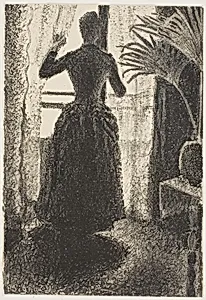
Medium
Lithograph in black, with scraping on stone, on cream wove paper
Dimensions
17.4 × 12 cm (6 7/8 × 4 3/4 in.)
Classification
lithograph
Department
Prints and Drawings
Museum
Art Institute of Chicago
Accession Number
80883
Rights
Public Domain
Art Historical Context
**Sunday in Paris** (1887) by Paulac captures the vibrant spirit of late 19th-century Parisian through a modest yet evocative print. Signac, a pioneering French-Impressionist and close collaborator of Georges Seurat, was at the forefront of the Pointillist movement during this period, experimenting with color theory and optical mixing. Created just as Divisionism gained traction, this work reflects the artist's early exploration of modern urban leisure, evoking a sunny "Sunday" outing amid the city's bustle—likely a bustling café or park scene inferred from the title. Rendered as a black lithograph with innovative scraping on the stone surface, the piece was printed on cream wove paper, measuring a intimate 17.4 × 12 cm. Lithography, a revolutionary 19th-century technique allowing artists to draw directly on limestone for fluid lines and tones, enabled Signac to achieve subtle textures and highlights through scraping, mimicking light effects akin to his later paintings. This method democratized art, making high-quality reproductions accessible beyond oil canvases. Housed in the Art Institute of Chicago's Prints and Drawings Department, **Sunday in Paris** exemplifies Signac's versatility across media and his commitment to bridging fine art with printmaking. Its small scale invites close viewing, revealing the meticulous craft that foreshadowed his luminous seascapes and cityscapes, offering visitors a window into the innovative world of Post-Impressionist experimentation.
About the Artist
Paul Signac · 1863–1935
Paul Signac (1863–1935) was a French Neo-Impressionist painter and theorist who became the leading practitioner and champion of Pointillism after the death of Georges Seurat. Born in Paris, he was initially inspired by the Impressionists, particularly Monet, before meeting Seurat in 1884 and becoming his most devoted follower and intellectual partner in developing the systematic color theory they ...