
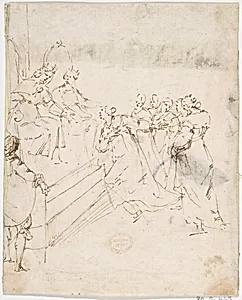
Supplicants before an Enthroned King and Queen
1624–63
Medium
Pen and brown ink
Dimensions
5-1/4 x 4-3/16 in. (13.4 x 10.7 cm)
Classification
Drawings
Department
Drawings and Prints
Museum
Metropolitan Museum of Art, New York, NY
Credit
Gift of Cornelius Vanderbilt, 1880
Accession Number
80.3.463
Rights
Public Domain
Tags
Art Historical Context
In the intimate world of 17th-century Italian drawings, Francesco Allegrini's *Supplicants before anroned King and Queen (1624–63) captures a moment of regal authority and humble petition. Rendered in pen and brown ink on a 5-1/4 x 4-3/16 inches sheet, this work from the Metropolitan Museum of Art's Drawings and Prints depicts figures approaching a throne, evoking the grandeur of courtly or biblical scenes common in Baroque art. Allegrini, a Gubbio-born draughtsman active in central Italy, favored such dynamic compositions, blending intricate line work with a sense of narrative drama. Pen and brown ink was a versatile medium for artists like Allegrini, allowing precise hatching and cross-hatching to model forms and convey texture—here, likely emphasizing the opulent robes of the king and queen against the supplicants' gestures of deference. This technique highlights the drawing's preparatory potential, though its standalone quality suggests it as a cherished *disegno* in its own right, prized by collectors for its immediacy and skill. A gift to the Met from Cornelius Vanderbilt in 1880, this piece offers a window into Baroque Italy's fascination with power dynamics and human interaction. Its small scale invites close contemplation, reminding visitors of drawing's enduring role as a foundation of grand artistic traditions.
About the Artist
Francesco Allegrini · 1615–1679
Francesco Allegrini (c. 1615/20–after 1679), born likely in Rome to the painter Flaminio Allegrini from Cantiano near Gubbio, emerged from a family of artists that included his sister, Anna Angelica Allegrini. He trained under Giuseppe Cesari, known as the Cavalier d’Arpino, around 1638–40, before entering the studio of Pietro da Cortona, whose dynamic Baroque style profoundly shaped his own. Elec...