
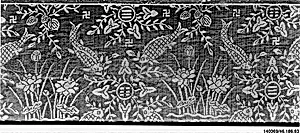
Sutra Cover with Fish, Lotuses, and Trigrams
Unknown Artist
16th century
Medium
Silk satin with supplementary weft patterning
Dimensions
Overall: 5 x 14 1/4 in. (12.7 x 36.2 cm)
Classification
Textiles-Woven
Culture & Period
China · Ming dynasty (1368–1644)
Department
Asian Art
Museum
Metropolitan Museum of Art, New York, NY
Credit
Rogers Fund, 1946
Accession Number
46.186.83
Rights
Public Domain
Tags
Art Historical Context
This exquisite *Sutra Cover with Fish, Lotuses, Trigrams* hails from China's Ming dynasty (13681644), a golden age of imperial refinement and artistic innovation. Crafted as a protective cover Buddhist sutras—sacred scriptures—the small silk panel (5 x 14¼ in.) reflects the era's reverence for spirituality and nature. Produced using luxurious silk satin with supplementary we patterning, a sophisticated weaving technique where additional threads create intricate designs without compromising the fabric's sheen, it exemplifies Ming textile mastery. The motifs are richly symbolic: pairs of fish evoke marital harmony and abundance, lotuses rising amid leaves represent purity and enlightenment in Buddhist lore, while the eight trigrams—drawn from Taoist cosmology in the *I Ching*—add layers of divination and cosmic balance. These elements blend Buddhist devotion with Confucian and Daoist influences, common in Ming decorative arts. Acquired through the Rogers Fund in 1946, this rare textile now graces the Metropolitan Museum of Art's Asian Art collection. It offers a window into how everyday religious objects became canvases for profound cultural expression, showcasing the Ming weavers' skill in merging beauty, symbolism, and spirituality.