
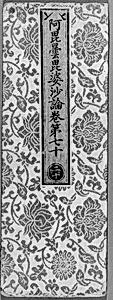
Sutra Cover with Floral Scroll
Unknown Artist
16th century
Medium
Silk satin with supplementary weft patterning
Dimensions
Overall: 5 x 14 1/4 in. (12.7 x 36.2 cm)
Classification
Textiles-Woven
Culture & Period
China · Ming dynasty (1368–1644)
Department
Asian Art
Museum
Metropolitan Museum of Art, New York, NY
Credit
Rogers Fund, 1946
Accession Number
46.186.32
Rights
Public Domain
Art Historical Context
This exquisite *Sutra Cover with Floral Scroll*, crafted in 16th-century Ming dynasty China, served as a protective wrapper for Buddhist sutras—sacred scriptures revered in East Asian religious practice. During the Ming period (1368–1644), a golden age of Chinese artistry, such textiles reflected the era's prosperity and devotion to Buddhism, often commissioned for temples or elite patrons. Measuring a compact 5 x 14¼ inches (12.7 x 36.2 cm), its delicate scale belies its cultural weight, now housed in the Metropolitan Museum of Art's Asian Art Department, acquired through the Rogers Fund in 1946. Woven from luxurious silk satin using supplementary weft patterning—a sophisticated technique where additional colored threads are inserted to form intricate designs atop a smooth satin ground—the cover bursts with a lively floral scroll motif. This method allowed artisans to achieve vibrant, multi-hued patterns without compromising the fabric's sheen, showcasing Ming weavers' mastery of loom technology and natural dyes derived from plants and insects. Beyond its beauty, the piece highlights China's enduring textile legacy, where silk symbolized imperial elegance and spiritual purity. Floral scrolls evoked abundance and harmony, aligning with Confucian and Buddhist ideals of balance in nature. Visitors will appreciate how this humble yet opulent object bridges art, faith, and craftsmanship from imperial China.