
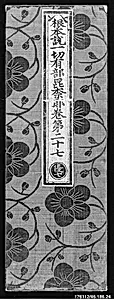
Sutra Cover with Prunus Scroll
Unknown Artist
16th century
Medium
Silk satin damask
Dimensions
Overall: 5 x 14 1/4 in. (12.7 x 36.2 cm)
Classification
Textiles-Woven
Culture & Period
China · Ming dynasty (1368–1644)
Department
Asian Art
Museum
Metropolitan Museum of Art, New York, NY
Credit
Rogers Fund, 1946
Accession Number
46.186.24
Rights
Public Domain
Art Historical Context
This exquisite *Sutra Cover with Prunus Scroll*, crafted in the 16th century during China's Ming dynasty (13681644), is a woven masterpiece of silk satin damask just 5 x 14¼ inches (12.7 x 36.2 cm). Produced by an unknown artist, it served as a protective wrapper for sutras—sacred scriptures rolled into scrolls. The intricate prunus (plum blossom) scroll pattern, with its flowing branches and delicate blooms, evokes the resilience of plum trees that flower amid winter's chill, a cherished symbol of perseverance and renewal in Chinese culture. Ming dynasty textiles like this one highlight the era's unparalleled weaving techniques. Silk satin damask achieves its luminous sheen and reversible pattern through a complex Jacquard-like loom process, where satin weaves create glossy highlights against a matte ground. This labor-intensive method, often supported by imperial workshops, produced luxury items for religious and elite use, blending functionality with artistry. Housed in the Metropolitan Museum of Art's Asian Art Department (acquired via the Rogers Fund in 1946), this cover offers a window into Ming China's devotion to Buddhism and mastery of silk production—one of the world's oldest textile traditions. Visitors will appreciate its compact elegance, a testament to the period's refined aesthetic.