
Suzanne
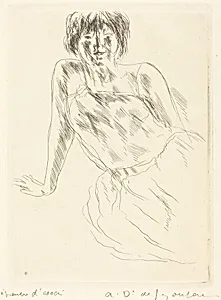
Medium
etching
Classification
Department
CG-W
Museum
National Gallery of Art, Washington, D.C.
Credit
Frank Crowninshield Collection
Accession Number
1948.3.105
Rights
Public Domain
Art Historical Context
**Suzanne**, a 1927 etching by artist André Dunoyer deonzac, captures the of the interwar period through its delicate lines and intimate portraiture. Segonzac, a prominent figure in the École de Paris, was renowned for his masterful draughtsmanship, blending realist precision with a lively, modern sensibility influenced by Impressionism and the post-World War I artistic renaissance. Created during the vibrant 1920s in Paris, this print reflects the era's fascination with personal expression and the human form, possibly depicting a poised female subject named Suzanne amid the cultural exuberance of the time. Etching, Segonzac's favored medium, allowed him to achieve exquisite tonal depth and spontaneity. The technique involves incising lines into a metal plate with acid, then inking and printing to produce rich, velvety textures—ideal for his fluid, calligraphic style. This work exemplifies his skill in translating the immediacy of drawing into enduring prints, making fine art more accessible. Housed in the National Gallery of Art's Frank Crowninshield Collection, **Suzanne** highlights Segonzac's contributions to 20th-century printmaking. Visitors will appreciate its subtle artistry, a window into 1920s France where tradition met modernity. (198 words)
About the Artist
André Dunoyer de Segonzac
André Dunoyer de Segonzac (1884–1974) was a leading French painter, draughtsman, engraver, and illustrator, born on 6 July in Boussy-Saint-Antoine near Paris, where he spent much of his childhood alongside time in the city. Defying his parents' initial hopes for a military career at Saint-Cyr, he pursued art, enrolling in 1900 at the École des Beaux-Arts in Paris as a general student. He studied u...