
Sword Guard (Tsuba)
Unknown Artist
ca. 1830–1860
Medium
Iron, copper-gold alloy (shakudō)
Dimensions
H. 2 3/4 in. (7 cm); W. 2 9/16 in. (6.5 cm); thickness 3/16 in. (0.5 cm); Wt. 3.9 oz. (110.6 g)
Classification
Sword Furniture-Tsuba
Culture
Japanese
Department
Arms and Armor
Museum
Metropolitan Museum of Art, New York, NY
Credit
Edward C. Moore Collection, Bequest of Edward C. Moore, 1891
Accession Number
91.1.804
Rights
Public Domain
Tags
Art Historical Context
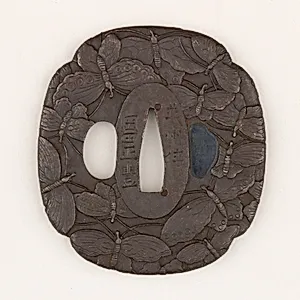
This exquisite **Sword Guard (Tsuba)**, crafted in Japan around 1830–1860 the late Edo period, exemplifies the masterful fusion of utility and artistry in samurai sword fittings. A tsuba serves as handguard on a katana or wakizashi, protecting the wielder's hand while preventing the blade from slipping. Far from mere armor, these guards were status symbols for samurai, often adorned with symbolic motifs that reflected nature, seasons, or philosophical ideals. Forged from iron and inlaid with shakudō—a copper-gold alloy prized for its deep, velvety black patina after chemical treatment—the tsuba features delicate butterfly designs. Butterflies, evoking transformation and fleeting beauty in Japanese culture, are rendered with precision, showcasing advanced metalworking techniques like nunome-zogan (gold inlay hammered into textured grounds). Measuring just 2¾ inches high, its compact form belies a weight of nearly 4 ounces, balancing strength and elegance. Part of the Metropolitan Museum of Art's Arms and Armor collection, gifted through the Edward C. Moore bequest in 1891, this anonymous masterpiece highlights the Edo era's peak in sword decoration, just before the Meiji Restoration ended traditional samurai ways. A testament to Japan's enduring metalcraft legacy. (198 words)