
Sword Guard (Tsuba)
Unknown Artist
ca. 1860
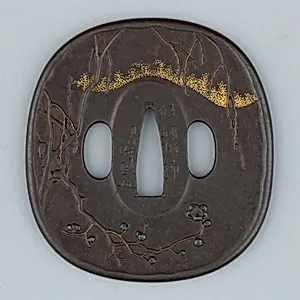
Medium
Iron, gold, silver, copper
Dimensions
H. 3 1/8 in. (7.9 cm); W. 2 7/8 in. (7.3 cm); thickness 3/16 in. (0.5 cm); Wt. 4.8 oz. (136.1 g)
Classification
Sword Furniture-Tsuba
Culture
Japanese
Department
Arms and Armor
Museum
Metropolitan Museum of Art, New York, NY
Credit
The Howard Mansfield Collection, Gift of Howard Mansfield, 1936
Accession Number
36.120.7
Rights
Public Domain
Tags
Art Historical Context
This exquisite sword guard, or *tsuba*, hails from Japan around 1860, during the waning years of the Edo period when samurai culture still flourished amid mounting social change. Crafted primarily from iron and inlaid with shimmering gold, silver, and copper, it measures just over 3 inches high and weighs nearly 5 ounces, blending robust functionality with delicate artistry. The design features trees—a common motif in Japanese art symbolizing endurance, seasonal cycles, and harmony with nature—evident in its intricate surface decoration. As a key element of sword furniture, the *tsuba* protected the hand while serving as a canvas for metalworkers' mastery. Artisans employed sophisticated techniques like *zōgan* inlay, where thin wires or sheets of precious metals were hammered into carved iron channels, creating a luminous contrast against the dark ground. This piece exemplifies the high level of craftsmanship in late Edo *tsuba* production, often made by workshops in cities like Edo (modern Tokyo). Part of the Metropolitan Museum of Art's Arms and Armor collection, gifted by Howard Mansfield in 1936, this *tsuba* highlights Japan's fusion of utility and aesthetics. Though unsigned, its materials and motif reflect the era's refined metalwork tradition, bridging weaponry and wearable sculpture for samurai elites.