
Sword Guard (Tsuba)
Unknown Artist
possibly 17th century
Medium
Iron, copper-gold alloy (shakudō), gold, copper
Dimensions
H. 2 3/8 in. (6 cm); W. 2 1/4 in. (5.7 cm); thickness 1/4 in. (0.6 cm); Wt. 2.1 oz. (59.5 g)
Classification
Sword Furniture-Tsuba
Culture
Japanese
Department
Arms and Armor
Museum
Metropolitan Museum of Art, New York, NY
Credit
Gift of Bashford Dean, 1919
Accession Number
19.154.2
Rights
Public Domain
Tags
Art Historical Context
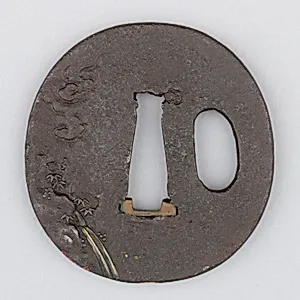
This elegant sword guard, known as a *tsuba*, hails from Japan and dates possibly to the 17th century, a golden age of samurai artistry during the Edo period. a vital component of the katana or wakizashi sword, the tsuba served a practical purpose—shielding the wielder's hand from an opponent's blade—while doubling as a canvas for exquisite decoration. Crafted for discerning warriors and collectors, such guards elevated weaponry to wearable sculpture, blending utility with refined aesthetics. Forged primarily from iron, this tsuba is enriched with shakudō (a copper-gold alloy prized for its deep black patina), gold, and copper, suggesting sophisticated inlay techniques like *zōgan* or *hōmon-zōgan*. These methods allowed artisans to create intricate designs, likely featuring male figures as hinted by its motifs, symbolizing strength, valor, or legendary tales. Measuring just 2 3/8 by 2 1/4 inches, its compact form and 2.1-ounce weight belie the masterful precision required. A gift to the Metropolitan Museum of Art from Bashford Dean in 1919, this piece exemplifies Japan's Arms and Armor tradition, where even functional objects embodied cultural ideals of harmony, discipline, and beauty. Visitors, imagine it gleaming on a daimyo's hilt—timeless proof of the samurai's dual role as fighter and connoisseur.