
Sword Guard (Tsuba)
Unknown Artist
ca. 1615–1868
Medium
Iron, gold, copper
Dimensions
H. 2 7/8 in. (7.3 cm); W. 2 3/4 in. (7 cm); thickness 5/16 in. (0.8 cm); Wt. 3.9 oz. (110.6 g)
Classification
Sword Furniture-Tsuba
Culture
Japanese
Department
Arms and Armor
Museum
Metropolitan Museum of Art, New York, NY
Credit
H. O. Havemeyer Collection, Bequest of Mrs. H. O. Havemeyer, 1929
Accession Number
29.100.976
Rights
Public Domain
Tags
Art Historical Context
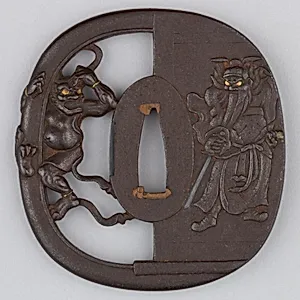
This finely crafted **Sword Guard (Tsuba)** hails from Japan's Edo period (ca.1615–1868), a time of relative peace when samurai culture shifted toward artistic refinement. As the handguard on a katana wakizashi sword, the tsuba served both a practical purpose—preventing the hand from slipping onto the blade—and an aesthetic one, transforming weapons into wearable art. Measuring just under 3 inches across, this iron example weighs a substantial 3.9 ounces, underscoring the robust metallurgy of Japanese sword fittings. Adorned with gold and copper inlays, the tsuba likely employs traditional techniques like *zōgan* (metal inlay), where softer metals are hammered into carved iron surfaces for vibrant contrast. Its motifs of men and demons evoke Japan's rich yokai folklore—mythical beings like oni (ogres) often symbolizing chaos tamed by human valor. These designs not only showcased the anonymous artisan's skill but also reflected Edo-era values of harmony between the mortal and supernatural worlds. A gem from the H.O. Havemeyer Collection, bequeathed to The Metropolitan Museum of Art in 1929, this tsuba highlights the global allure of Japanese arms and armor, blending martial tradition with exquisite craftsmanship.