
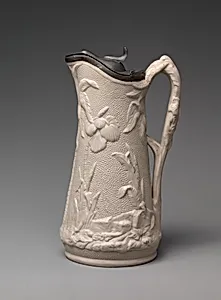
Syrup Jug
Medium
Parian porcelain
Dimensions
7 1/2 x 4 1/2 x 3 3/4 in. (19.1 x 11.4 x 9.5 cm)
Classification
Syrup jug
Culture
American
Department
The American Wing
Museum
Metropolitan Museum of Art, New York, NY
Credit
Gift of Dr. Charles W. Green, 1947
Accession Number
47.90.92
Rights
Public Domain
Tags
Art Historical Context
Step into the elegant world of mid-19th-century Americanware with this charming *Syrup Jug* from United States Pottery Company, between 1852 and 1858. Measuring a compact 7½ x 4½ x 3¾ inches, piece exemplifies the company's ambition to rival European porcelain makers. Made of Parian porcelain—a fine, unglazed material mimicking the soft glow of Parian marble from ancient Greece—it was prized for its matte, ivory-like finish that highlighted delicate details, such as the floral motifs adorning its surface. Produced in Bennington, Vermont, by one of America's pioneering pottery firms, the jug reflects the era's industrial boom and growing national pride in domestic craftsmanship. Parian ware, introduced in the 1840s, marked a leap for U.S. potters, who adapted European techniques to create affordable yet sophisticated decorative objects for the home. This syrup jug blended functionality with artistry, transforming everyday dining into a display of refinement. Housed in The Met's American Wing and gifted by Dr. Charles W. Green in 1947, it captures the cultural shift toward accessible luxury in antebellum America, where floral designs evoked the natural beauty celebrated in Victorian homes. A delightful survivor of its time!