
Syrup Jug
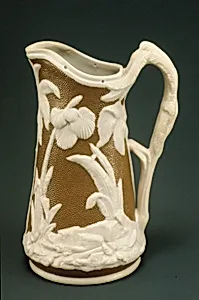
Medium
Parian porcelain
Dimensions
7 x 4 7/8 x 3 15/16 in. (17.8 x 12.4 x 10 cm)
Classification
Syrup jug
Culture
American
Department
The American Wing
Museum
Metropolitan Museum of Art, New York, NY
Credit
Gift of Dr. Charles W. Green, 1947
Accession Number
47.90.171
Rights
Public Domain
Tags
Art Historical Context
Nestled in the American Wing of the Metropolitan Museum Art, this delicate Syrup Jug, crafted by the United States Company between 1852 and 1858, exemplifies mid-19th-century American in ceramics. Made of Parian porcelain—an unglazed, matte white bisque that imitates the translucency and smoothness of Parian marble from the Greek island of Paros—this measures a modest 7 x 4 7/8 x 3 15/16 inches, perfect for the Victorian dining table. The United States Pottery Company, based in Bennington, Vermont was a pioneer in producing affordable luxury wares during the Industrial Revolution. Parian porcelain, popular from the 1840s onward, allowed American potters to rival European imports with sculptural elegance on everyday objects like this syrup jug, often adorned with floral motifs that evoke nature's abundance. Its pristine surface highlights intricate flower designs, blending functionality with ornamental charm. Gifted to the Met in 1947 by Dr. Charles W. Green, this piece reflects the era's growing American pride in domestic manufacturing and the rise of middle-class refinement. Visitors will appreciate how it captures a moment when U.S. ceramics transitioned from utilitarian stoneware to sophisticated, marble-like finery.