
T-Cart Phaeton #3295
1878
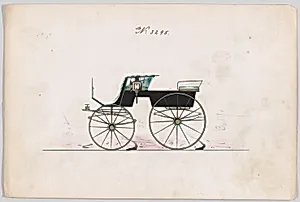
Medium
Pen and black ink, watercolor and gouache with gum arabic
Dimensions
Sheet: 6 3/8 × 9 11/16 in. (16.2 × 24.6 cm)
Classification
Drawings
Department
Drawings and Prints
Museum
Metropolitan Museum of Art, New York, NY
Credit
Gift of William Brewster, 1923
Accession Number
23.112.1104
Rights
Public Domain
Tags
Art Historical Context
Step into the elegant world of 19th-century carriage design with *T-Cart Phaeton #3295*, a 1878 drawing by renowned New York firm Brewster & Co. This delicate work on paper captures the sleek lines of a lightweight phaeton—a popular open carriage favored by the elite for leisurely drives through city parks and country estates. Measuring just 6 3/8 × 9 11/16 inches, it exemplifies the drafting used by coachbuilders to showcase their craftsmanship. Brewster & Co., established in 1810, was America's premier carriage maker during the Gilded Age, crafting bespoke vehicles for tycoons like the Vanderbilts and Astors. This T-cart phaeton reflects the era's blend of utility and luxury, with its nimble two-wheeled design ideal for one or two passengers. Donated to the Metropolitan Museum of Art in 1923 by William Brewster, the drawing preserves a vanishing world on the cusp of the automobile age, highlighting how carriages were rolling symbols of status and refined engineering. Rendered in pen and black ink with watercolor, gouache, and gum arabic, the piece employs luminous techniques to evoke polished wood, gleaming metal, and rich upholstery. The gum arabic adds a glossy sheen, mimicking the carriages' varnished finishes. As part of the Met's Drawings and Prints collection, it invites us to appreciate the artistry behind everyday opulence.
About the Artist
Brewster & Co. · 1837–present
**Brewster & Co.** Brewster & Company, a premier American coachbuilder renowned for its exquisite carriage designs, was established in 1810 in New Haven, Connecticut, by James Brewster (1788–1866). Born in 1788, Brewster trained as a wagonmaker's apprentice starting at age 16 in Northampton, Massachusetts, before relocating to New Haven, where he set up his workshop and quickly gained acclaim for...