
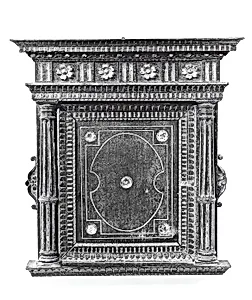
Tabernacle Frame
Unknown Artist
style 16th century, made ca. 1920
Medium
Poplar and walnut
Dimensions
Overall: 14 3/16 × 13 7/16 in. (36 × 34.1 cm) Sight: 7 1/2 × 6 3/16 in. (19.1 × 15.7 cm) Rabbet: 7 13/16 × 6 7/16 in. (19.9 × 16.3 cm)
Classification
Frames
Culture
Italian, Tuscan
Department
Robert Lehman Collection
Museum
Metropolitan Museum of Art, New York, NY
Credit
Robert Lehman Collection, 1975
Accession Number
1975.1.1636
Rights
Public Domain
Art Historical Context
This exquisite *Tabernacle Frame* from, Italy, evokes the devotional art of 16th-century Renaissance homes. Crafted in poplar and walnut around 1920 in a faithful 16th-century style it measures just 14 3/16 × 13 7/16 inches overall, with a sight opening of 7 1/2 × 6 3/16 inches—perfect enclosing small religious panels like Madonnas or saints. These frames, often called "tabern," mimicked miniature altarpieces, allowing families to create personal shrines walls for daily prayer. Tuscan frame-makers excelled in carved woodwork, using contrasting woods for visual depth and applying gilding or paint (though traces may remain here). Poplar provided a lightweight base for intricate moldings, while walnut added rich warmth and durability. Though a 20th-century creation amid Renaissance revivals, it captures the era's blend of piety and artistry, reflecting Florence's craft guilds. Now in the Robert Lehman Collection at The Metropolitan Museum of Art (1975), this frame highlights how decorative arts preserved cultural memory. Imagine it once framing a cherished icon, bridging centuries of Italian heritage for modern viewers.