
Tabernakeldeur
c. 1600
Medium
ciselure
Dimensions
34.5; 43.5; 45.5; 33.5
Rights
Public Domain
About this artwork
hoogte 43,5 cm (plaquette) x breedte 33,5 cm (plaquette) x hoogte 45,5 cm (paneel) x breedte 34,5 cm (paneel)
Art Historical Context
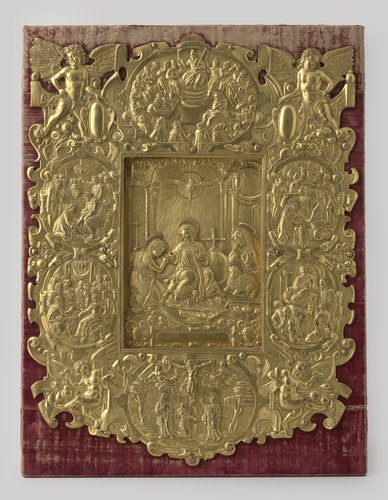
### Tabernakeldeur (Tabernacle Door), c. 1600 This exquisite *Tabernakeldeur*, or tabernacle door, crafted anonymously around 1600, served as a protective and decorative panel for the tabernacle in a Catholic church—a sacred vessel housing the Eucharist. Measuring approximately 43.5 high by 33.5 cm wide (with the full panel slightly larger at 45.5 cm x 34.5 cm), its compact size made it ideal for altar integration. The medium, *ciselure* (a French term for fine metal chasing and engraving), highlights the artisan's mastery in hammering soft metal like silver or brass from the reverse side to create intricate raised reliefs, often adorned with gilding or patina for a luminous effect. Dating to the early Baroque era in the Spanish Netherlands (modern-day Belgium and the Netherlands), this piece reflects the Counter-Reformation's emphasis on ornate religious art to inspire devotion amid Protestant challenges. Anonymous workshops thrived in cities like Antwerp, producing such doors with symbolic motifs—likely angels, saints, or Eucharistic scenes—elevating everyday liturgy into visual splendor. The *ciselure* technique, demanding precision and patience, underscores the era's blend of Gothic detail and emerging Baroque drama. Visitors, imagine the soft glow of candlelight dancing across its textured surface during Mass—a testament to faith's enduring artistry. Though unattributed, its survival speaks to centuries of reverence.
About the Artist
anonymous
In the vast tapestry of art history, "Anonymous" stands not as a singular individual but as a collective designation for countless unidentified creators whose works have endured across millennia. These artists, spanning prehistoric cave painters to medieval illuminators and folk craftsmen, produced the foundational layers of human visual culture. Prior to the Renaissance, when individual fame emer...