
Table
c. 1800
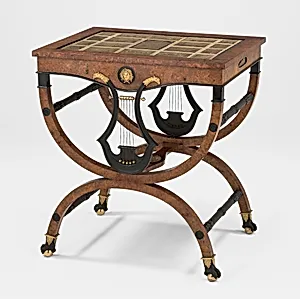
Medium
Burl maple, fir or pine, gilt bronze, and marble
Dimensions
78.5 × 72.1 × 55.3 cm (30 7/8 × 28 3/8 × 21 3/4 in.)
Classification
table
Department
Applied Arts of Europe
Museum
Art Institute of Chicago
Accession Number
180740
Rights
Public Domain
About this artwork
This table is a rare example of the work of Friedrich Gilly, who was born in Pomerania, which is now part of Poland but was then part of the Kingdom of Prussia. Gilly trained with his architect father David Gilly, who had founded an important school of architecture in Berlin in 1793. A 1797 study trip through Austria, England, and France had a profound influence on the younger Gilly’s work. Friedrich did important architectural and interior design work for royal palaces and other buildings in Be...
Art Historical Context
Nestled in the Art Institute of Chicago's Department of Applied Arts of Europe *Table* (c. 1800) by Friedrich Gilly exemplifies refined elegance of Neoclassical design. Crafted from luxurious burl maple—prized for its dramatic, swirling grain—fir or pine for structural support, ornate gilt bronze mounts, and a polished marble top, this piece measures a compact 78.5 × 72.1 × 55.3 cm, making it an ideal centerpiece for an intimate salon or study. Gilly, a visionary Prussian architect who died tragically young at age 28, bridged architecture and decorative arts during the late Enlightenment era. Active around 1800, his work reflects the Neoclassical movement's obsession with ancient Greek and Roman forms, emphasizing symmetry, proportion, and understated opulence. The table's materials highlight innovative woodworking techniques and metalworking, where gilt bronze added a shimmering, imperial touch inspired by antiquity, signaling wealth and sophistication in elite European households. This exquisite furniture not only served practical purposes but also embodied cultural aspirations of harmony and classical revival, inviting visitors to appreciate how everyday objects became canvases for artistic ambition. A true gem of applied arts!