
Table (Occasional)
c. 1936
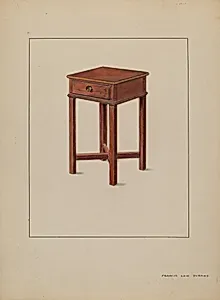
Medium
watercolor, colored pencil, pen and ink, graphite,and heightening on paperboard
Dimensions
overall: 30.6 x 22.8 cm (12 1/16 x 9 in.) Original IAD Object: 17"square; 28 1/4"high
Classification
Index of American Design
Department
CG-W
Museum
National Gallery of Art, Washington, D.C.
Credit
Index of American Design
Accession Number
1943.8.5723
Rights
Public Domain
Art Historical Context
Behold the delicate rendering of *Table (Occasional)* by Francis Law Durand, created around 1936 as part of the Index of American Design. This watercolor, colored pencil, pen and ink, graphite, and heightening on paperboard (30.6 x 22.8 cm) meticulously captures an elegant occasional table—17 inches square with a height of 28¼ inches—showcasing everyday American craftsmanship from an earlier era. Such tables served as versatile accents in homes, blending functionality with subtle decorative charm. Durand's work emerged from the Federal Art Project of the Works Progress Administration (WPA) during the Great Depression, a bold initiative that employed artists to document the nation's folk, vernacular, and decorative arts. The Index of American Design produced over 15,000 such precise illustrations to preserve cultural heritage amid economic hardship, ensuring that ordinary objects like this table were celebrated as vital threads in America's design story. Through layered techniques—vibrant watercolors for depth, fine ink lines for precision, and heightening for luminous highlights—Durand elevates the mundane to the masterful. Housed in the National Gallery of Art, this piece invites us to appreciate how WPA artists transformed historical artifacts into enduring visual records, bridging past ingenuity with modern admiration.
About the Artist
Francis Law Durand · 1855–present
**Francis Law Durand (1906–1995)** Born on March 31, 1906, in Mount Holly, New Jersey, Francis Law Durand emerged as a skilled American draftsman and artist during the Great Depression era. Little is known about his early life or formal training, as biographical details remain sparsely documented beyond his professional output. By 1935, he was employed by the Works Progress Administration (WPA), ...