
Tahitian Faces (Frontal View and Profiles)
ca. 1899
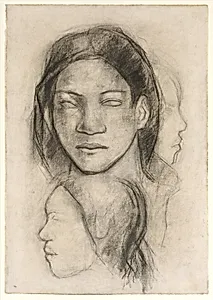
Medium
Charcoal on laid paper
Dimensions
Sheet: 16 1/8 x 12 1/4 in. (41 x 31.1 cm)
Classification
Drawings
Department
Drawings and Prints
Museum
Metropolitan Museum of Art, New York, NY
Credit
Purchase, The Annenberg Foundation Gift, 1996
Accession Number
1996.418
Rights
Public Domain
Tags
Art Historical Context
Paul Gauguin created *Tahitian Faces (Frontal View and Profiles)* around 1899 during his extended stay in French Polynesia. Seeking escape from industrialized Europe, the Post-Impressionist artist immersed himself in Tahitian life, producing numerous drawings and paintings that explored local people and landscapes. This charcoal study reflects his fascination with the human form and cultural “otherness,” themes central to his late career. Rendered on laid paper with soft, velvety charcoal, the sheet presents three views of a woman’s face—frontal and two profiles—allowing Gauguin to examine contour, expression, and shadow. Such multi-view studies often served as preparatory material for his larger canvases, yet they also stand alone as sensitive records of individual likeness. The medium’s rich tonal range captures both the gentle modeling of features and the quiet dignity of the sitter. Today housed in the Metropolitan Museum of Art, the drawing offers visitors an intimate glimpse into Gauguin’s working process and his enduring dialogue between European modernism and Tahitian life.
About the Artist
Paul Gauguin · 1848–1903
Paul Gauguin (1848-1903) was a French Post-Impressionist painter whose bold experiments with color, form, and subject matter made him one of the most influential figures in the transition from 19th-century art to modernism. His rejection of European civilization for the perceived authenticity of 'primitive' cultures established an archetype of artistic exile that continues to resonate. Gauguin's ...