
Tahitian Heads
c. 1891/1893
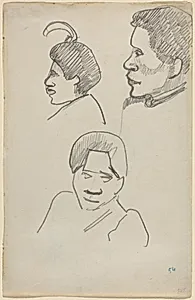
Medium
graphite on wove paper
Dimensions
overall: 16.5 x 10.8 cm (6 1/2 x 4 1/4 in.)
Classification
Drawing
Department
CG-E
Museum
National Gallery of Art, Washington, D.C.
Credit
The Armand Hammer Collection
Accession Number
1991.217.30
Rights
Public Domain
Art Historical Context
Paul Gauguin's *Tahitian Heads*, created around 1891–1893, captures the artist's fascination with Polynesian life during his transformative stay in Tahiti. A modest graphite drawing on wove, measuring just 16.5 x 10.8 cm, it exemplifies Gauguin's shift from European Impressionism toward-Impressionism and Primitivism. Arriving in Tahiti in 1891, Gauguin sought escape from modern civilization, immersing himself in indigenous culture to inspire simplified forms, bold contours, and symbolic depth—hallmarks of his mature style. This intimate sketch likely served as a preparatory study, showcasing Gauguin's keen observation of Tahitian faces. Graphite on wove paper allowed for delicate shading and precise lines, a practical medium for rapid fieldwork. Though smaller than his vibrant oil paintings like *Ia Orana Maria*, it reveals the raw groundwork behind his exotic visions, blending portraiture with cultural idealization. Housed in the National Gallery of Art as part of The Armand Hammer Collection, *Tahitian Heads* offers a window into Gauguin's quest for authenticity amid controversy over his romanticized depictions of Tahiti. A gem for drawing enthusiasts, it highlights how sketches fueled one of art history's most evocative odysseys.
About the Artist
Paul Gauguin · 1848–1903
Paul Gauguin (1848-1903) was a French Post-Impressionist painter whose bold experiments with color, form, and subject matter made him one of the most influential figures in the transition from 19th-century art to modernism. His rejection of European civilization for the perceived authenticity of 'primitive' cultures established an archetype of artistic exile that continues to resonate. Gauguin's ...