
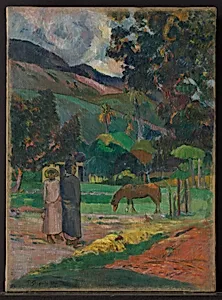
Tahitian Landscape
1892
Medium
Oil on canvas
Dimensions
25 3/8 x 18 5/8 in. (64.5 x 47.3 cm)
Classification
Paintings
Department
European Paintings
Museum
Metropolitan Museum of Art, New York, NY
Credit
Anonymous Gift, 1939
Accession Number
39.182
Rights
Public Domain
Tags
Art Historical Context
Paul Gauguin painted *Tahitian Landscape* in 1892 during his first extended stay in Tahiti, where he sought to escape what he viewed as the constraints of European society. The oil-on-canvas work captures the lush, tropical environment of the island, featuring figures, horses, and verdant scenery that reflect the artist’s fascination with what he idealized as a simpler, more authentic way of life. Created shortly after his arrival, the painting belongs to a pivotal series that helped define his mature vision of the South Pacific. Gauguin worked in a Post-Impressionist mode often called Synthetism, using bold, non-naturalistic colors and flattened forms rather than traditional perspective or shading. The medium of oil on canvas allowed him to layer rich pigments that evoke the intense light and saturated hues of Tahiti. These choices moved away from Impressionist optical effects toward a more decorative, symbolic approach that influenced later modern movements. Today in the Metropolitan Museum of Art’s European Paintings collection, the work offers visitors a window into Gauguin’s complex engagement with colonial-era exoticism and his lasting impact on twentieth-century art.
About the Artist
Paul Gauguin · 1848–1903
Paul Gauguin (1848-1903) was a French Post-Impressionist painter whose bold experiments with color, form, and subject matter made him one of the most influential figures in the transition from 19th-century art to modernism. His rejection of European civilization for the perceived authenticity of 'primitive' cultures established an archetype of artistic exile that continues to resonate. Gauguin's ...