
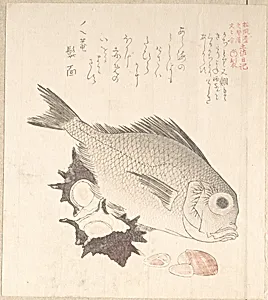
Tai Fish and Top-Shells
19th century
Medium
Woodblock print (surimono); ink and color on paper
Dimensions
8 x 7 1/8 in. (20.3 x 18.1 cm)
Classification
Prints
Culture & Period
Japan · Edo period (1615–1868)
Department
Asian Art
Museum
Metropolitan Museum of Art, New York, NY
Credit
H. O. Havemeyer Collection, Bequest of Mrs. H. O. Havemeyer, 1929
Accession Number
JP2080
Rights
Public Domain
Tags
Art Historical Context
Kubo Shunman's *Tai Fish and Top-S* is a captivating 19th-century woodblock from Japan's Edo period (1615–1868), showcasing the artist's mastery in the surimono tradition. Surimono, or "printed things," were luxurious, privately commissioned prints often produced for New Year's celebrations or poetry gatherings, featuring intricate designs on smaller scales. Here, Shunman depicts a vibrant sea bream (tai) and glossy top-shells with lifelike precision, their scales and textures rendered in rich inks and colors on delicate paper, measuring just 8 x 7 1/8 inches. This intimate still life exemplifies ukiyo-e artistry, where everyday subjects like fish and shellfish symbolized abundance and good fortune—tai, in particular, evokes celebrations due to its homophone with "medetai" (congratulations). Shunman's technique highlights the woodblock process: carved blocks layered with pigments for depth and shimmer, often enhanced with mica or embossing for a tactile quality. As part of the Metropolitan Museum of Art's H. O. Havemeyer Collection, it reflects the global fascination with Japanese prints during the late 19th century. Visitors will appreciate how this piece bridges nature's beauty with cultural rituals, inviting a closer look at Edo Japan's refined aesthetic.
About the Artist
Kubo Shunman · 1757–1820
Japanese, 1757–1820