
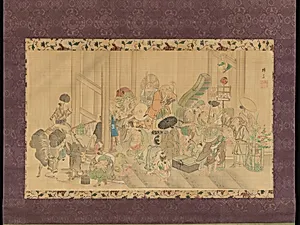
蹄斎北馬筆 雨宿り図|Taking Shelter from the Rain
early to mid-19th century
Medium
Hanging scroll; ink and color on silk
Dimensions
Image: 15 1/2 × 27 5/16 in. (39.4 × 69.3 cm) Overall with mounting: 51 15/16 × 32 5/16 in. (132 × 82 cm) Overall with knobs: 51 15/16 × 34 3/4 in. (132 × 88.3 cm)
Classification
Paintings
Culture & Period
Japan · Edo period (1615–1868)
Department
Asian Art
Museum
Metropolitan Museum of Art, New York, NY
Credit
Mary Griggs Burke Collection, Gift of the Mary and Jackson Burke Foundation, 2015
Accession Number
2015.300.152
Rights
Public Domain
Tags
Art Historical Context
**Taking Shelter from the Rain (*Ama-yadori-zu*), a delicate hanging scroll by Teisai Hokuba, captures a poignant moment from everyday Japanese life in the early to mid-19th century. Created during the Edo period (5–1868), this ink and color on silk painting (39.4 × 69.3 cm) depicts, women, children, an ox huddled together under a thatched shelter, evading a sudden downpour. Hokuba, a talented pupil of the famed ukiyo-e master Katsushika Hokusai, infused the scene with the lively, observational style of the "floating world" genre, blending humor and humanity in ordinary encounters. Hanging scrolls like this were prized treasures in Japanese homes and temples, unrolled for display during rainy seasons or gatherings to evoke shared experiences. The silk medium allowed for vibrant pigments and subtle ink washes, highlighting Hokuba's mastery of light, texture, and movement—raindrops glisten, fabrics cling, and figures convey quiet camaraderie. This work reflects Edo Japan's urban vibrancy, where art celebrated the beauty in transience, much like cherry blossoms or passing showers. From the Mary Griggs Burke Collection at the Metropolitan Museum of Art, it invites us to pause and appreciate the universal shelter of community amid life's storms.
About the Artist
Teisai Hokuba · 1771–1844
Teisai Hokuba (1771–1844) was a Japanese artist of the Edo period who worked in the tradition of ukiyo-e, the celebrated school of woodblock prints and paintings that depicted the floating world of urban pleasure, theater, landscape, and daily life. A devoted pupil of Katsushika Hokusai — one of the towering figures in the history of Japanese art — Hokuba adopted the prefix of his master's name as...