
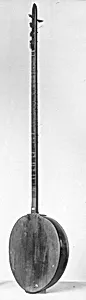
Tanbur Kabir Turki
Unknown Artist
late 19th century
Medium
Wood
Dimensions
132cm x 33cm x 21cm
Classification
Chordophone-Lute-plucked-fretted
Culture
Turkish
Department
Musical Instruments
Museum
Metropolitan Museum of Art, New York, NY
Credit
The Crosby Brown Collection of Musical Instruments, 1889
Accession Number
89.4.338
Rights
Public Domain
Art Historical Context
Nestled in the Metropolitan Museum of Art's Crosby Brown Collection of Musical Instruments acquired in 1889 the *Tanbur Kabir Tur* is a striking example of late 19th-century Turkish. This chordophone—a plucked, fretted lute—measures an impressive 132 cm in length, 33 cm width, and 21 in depth, crafted entirely from wood. Its size, with "kabir" meaning "great" in Turkish, suggests it was designed for powerful resonance, embodying the intricate woodworking techniques of Ottoman artisans who shaped resonant bodies and long necks to produce rich, sustained tones. In Turkish musical culture, the tanbur held a revered place in classical ensembles and Sufi devotional music, its fretted neck allowed precise intonation for intricate melodies known as *makam*. This instrument reflects the Ottoman Empire's vibrant tradition of lute-making, blending functionality with elegant form—smoothly carved wood that balanced acoustic projection and portability for performers. Today, the *Tanbur Kabir Turki* invites visitors to imagine the lively coffeehouses and palaces where it once sounded, preserving a slice of Turkey's sonic heritage amid the Met's vast collection of global instruments.