
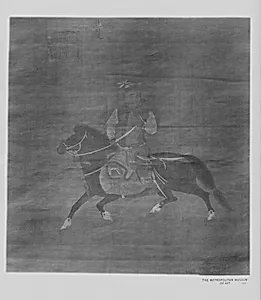
Tangut Horseman
Medium
Hanging scroll; ink and color on silk
Dimensions
39 1/2 x 28 1/2 in. (100.3 x 72.4 cm)
Classification
Paintings
Culture & Period
China · Ming dynasty (1368–1644) or later
Department
Asian Art
Museum
Metropolitan Museum of Art, New York, NY
Credit
John Stewart Kennedy Fund, 1913
Accession Number
13.100.19
Rights
Public Domain
Tags
Art Historical Context
Behold the striking *Tangut Horseman*, a hanging scroll painting in ink and color on silk, measuring an impressive 39½ x 28½ inches. Created by unidentified artist during China's Ming dynasty (1368–1644) or later, this work captures a lone rider on horseback, evoking the rugged spirit of Central Asian nomads. Displayed as a hanging scroll—a traditional format unrolled for intimate viewing in homes or temples—it invites contemplation of movement and power frozen in delicate brushwork. The Tangut people, linked to the medieval Western Xia kingdom in northwest China, were renowned horsemen and warriors, and this artwork likely commemorates their legacy centuries after their empire's fall. In Ming-era Chinese painting, such equestrian portraits blended Confucian ideals of heroism with ethnic diversity, showcasing the empire's vast cultural reach. The use of silk as a support highlights technical mastery: its luminous surface enhances vibrant colors and fluid ink lines, allowing the horse's dynamic pose and the rider's attire to leap to life. Acquired in 1913 through the John Stewart Kennedy Fund and now housed in the Metropolitan Museum of Art's Asian Art department, this piece offers a window into China's artistic fascination with the "other"—a timeless blend of history, skill, and wanderlust.